Why This Matters
The Yucatán Peninsula has no rivers in the conventional sense. Here, water flows almost entirely underground.
The System
A vast network of water-bearing fractures, cave systems, and fully saturated limestone forms one of the largest connected coastal aquifers on Earth.
This system provides drinking water for millions of people, sustains mangroves and wetlands, and directly influences the stability of coastal ecosystems and offshore reefs.
Yet despite nearly all life in the region depending on it, its functioning remains only partially understood.
We know the water moves. We rarely know exactly where it goes.
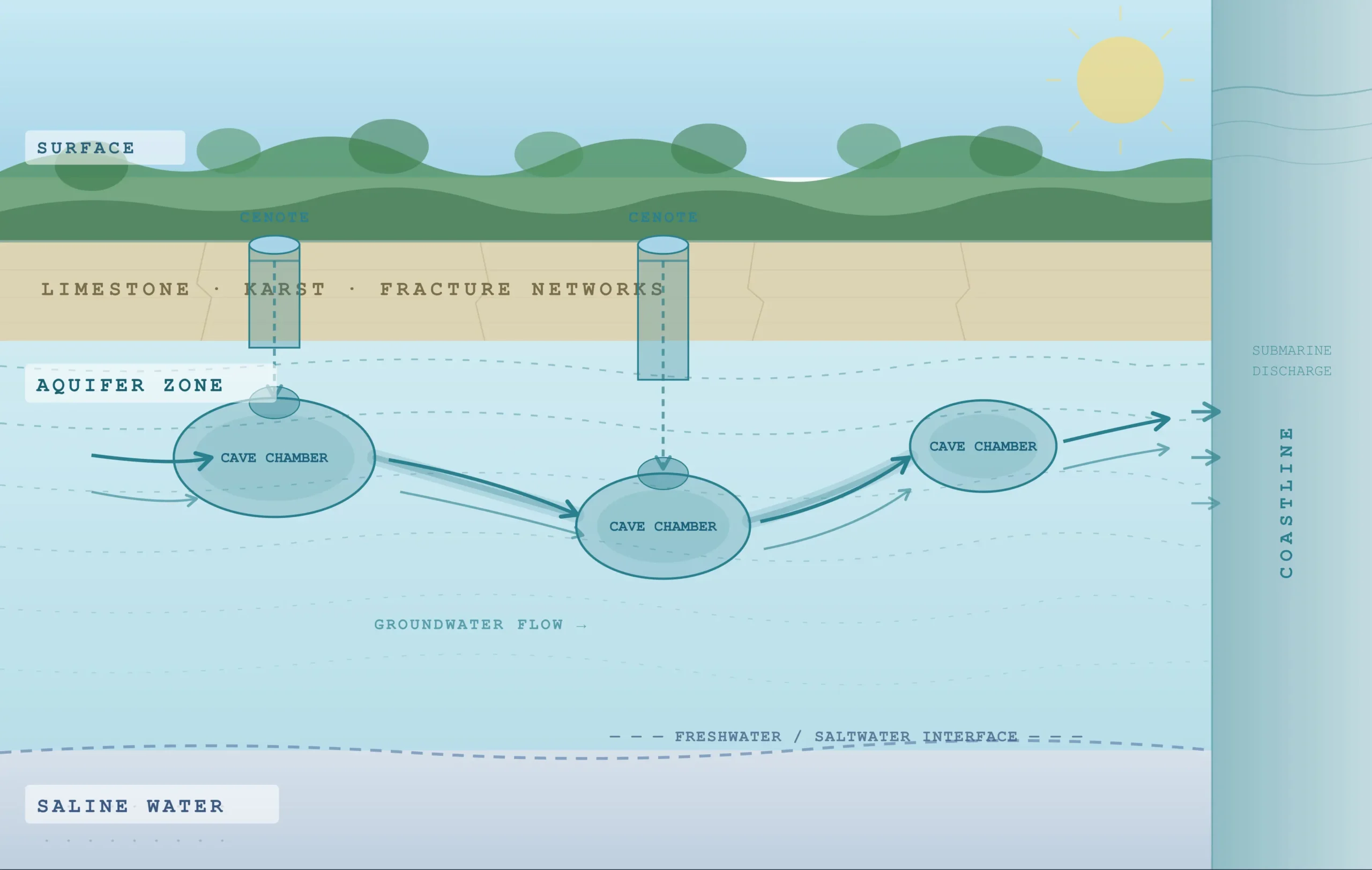
You cannot protect what you do not understand
The core premise of this research
The aquifer is directly
connected to everything.
Contamination does not remain local. It travels — often for many kilometers — through an invisible network. The aquifer links cities, farmland, tourism infrastructure, coastal lagoons, mangroves, and coral reefs into a single, vulnerable system.

Cities & Settlements
Millions rely on this aquifer for daily drinking water.

Agriculture
Fertilisers and pesticides infiltrate the porous limestone directly.

Tourism Development
Infrastructure growth outpaces scientific understanding of impacts.

Coastal Lagoons
Groundwater discharge shapes salinity and ecosystem health.

Mangroves
The freshwater–saltwater balance determines where mangroves thrive.

Coral Reefs
Submarine groundwater discharge directly nourishes offshore reef systems.
Without understanding flow paths, protection is almost impossible.
You cannot protect what you do not understand.
A Race Against Time
Regional development is advancing faster than scientific understanding of the system. Urbanisation, infrastructure, and land use are already affecting water quality at a scale that demands urgent attention.
At the same time, coastal ecosystems are increasingly sensitive to changes in the underground water balance — changes that, once set in motion, are difficult to reverse.
The question is not whether change will occur — but whether we understand it in time.
More Than a Regional Project
Similar coastal karst systems exist around the world. This project does not only seek to understand a single aquifer — it aims to develop a methodological framework applicable to comparable regions globally.
The scientific tools, investigative approach, and resulting models are designed to be transferable. What is learned here carries implications far beyond the Yucatán Peninsula.
“What is learned here can be applied elsewhere.”
Objective
Make the functioning of an entire
water system visible.
The goal is not simply to map caves. The goal is to trace the full journey of water — from atmosphere to surface, into the subsurface, and back to the sea — and to understand the system as a living, dynamic whole.
Only then can we know what to protect, and how.
Only once its pathways are understood can it be protected.